All content on this site is intended for healthcare professionals only. By acknowledging this message and accessing the information on this website you are confirming that you are a healthcare professional.
The SOT Hub website uses a third-party service provided by Google that dynamically translates web content. Translations are machine generated, so may not be an exact or complete translation, and the SOT Hub cannot guarantee the accuracy of translated content. The SOT Hub and its employees will not be liable for any direct, indirect, or consequential damages (even if foreseeable) resulting from use of the Google Translate feature. For further support with Google Translate, visit Google Translate Help.


The Solid Organ Transplantation Hub is an independent medical education platform, sponsored by Therakos. Funders are allowed no direct influence on our content. The levels of sponsorship listed are reflective of the amount of funding given. View funders.
Now you can support HCPs in making informed decisions for their patients
Your contribution helps us continuously deliver expertly curated content to HCPs worldwide. You will also have the opportunity to make a content suggestion for consideration and receive updates on the impact contributions are making to our content.
Find out more
Create an account to access:
Bookmark & personalize site content
Receive alerts for new content in your areas of interest
View solid organ transplantation content recommended for you
 Andrew Gelman
Do you know... Which of the following best describes preclinical findings supporting a potential antifibrotic mechanism of ECP in lung transplantation?
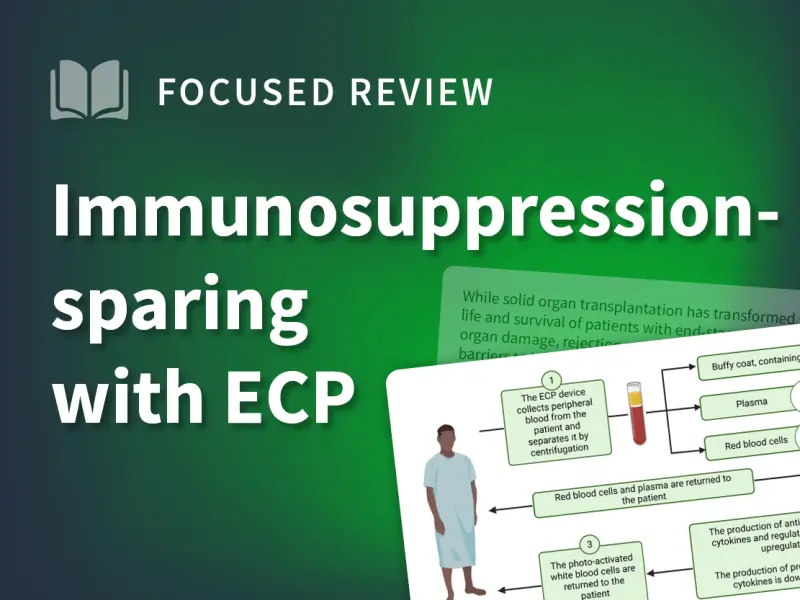
The SOT Hub spoke with Andrew Gelman, Washington University School of Medicine, St. Louis, US, about the mechanistic basis for the potential antifibrotic effects of extracorporeal photopheresis (ECP) in solid organ transplantation (SOT).
Mechanistic basis for the potential antifibrotic effects of ECP in SOT
Fibrosis is a hallmark of chronic allograft rejection, in which alloimmune responses and autoimmune responses against self-antigens can perpetuate one another, resulting in tissue inflammation and repair processes that contribute to a proinflammatory and profibrotic environment with fibrous tissue deposition.1 Vascular injury and alloimmune activation may stimulate the release of bioactive mediators, including transforming growth factor-beta (TGF-β), which regulate immune cell and fibroblast responses, and contribute to inflammation and extracellular matrix remodeling. While these mediators can support normal tissue repair, persistent signaling may promote pathological remodeling, fibrosis, and chronic graft dysfunction.2
In this interview, Gelman discusses potential mechanisms underlying the antifibrotic effects of ECP, highlighting preclinical findings implicating alveolar macrophages (AMs), TGF-β, and decorin.
Key points
- ECP is an established leukapheresis-based immunomodulatory therapy that does not cause generalized immunosuppression. However, its mechanism of action, including its potential antifibrotic effects, is not completely understood. 3, 4
- Macrophages are key regulators of fibrotic processes; during rejection, they can shift to a proinflammatory phenotype and promote fibrosis through the release of profibrotic mediators, including TGF-β. 3, 5, 6
- Chronic activation of TGF-β can promote fibrotic remodeling through fibroblast-to-myofibroblast transition and extracellular matrix accumulation.2
- Elevated TGF-β levels have been associated with chronic graft complications, such as the development of bronchiolitis obliterans syndrome (BOS) in lung transplant recipients, chronic cholangiopathy in liver transplant, and chronic allograft nephropathy in kidney transplant.2
- Findings from a murine lung transplant model of BOS suggest a potential mechanism through which ECP may modulate fibrotic processes.7
- ECP-treated leukocytes were primarily engulfed by AMs, suggesting that these cells may be important mediators of ECP’s effects.7
- TGF-β1 levels in bronchoalveolar lavage (BAL) fluid did not differ between ECP- vs saline-treated recipients; however, TGF-β activity in BAL fluid was lower with ECP, suggesting ECP may alter TGF-β bioavailability.7
- ECP-treated AMs showed significant upregulation of TGF-β inhibitors including Dcn, Smad7, and Smurf2, with Dcn the most differentially regulated transcript.7
- Secretion of decorin, a TGF-β antagonist, was higher from ECP-treated AMs than saline-treated AMs.7
- Supernatants from ECP-treated AMs reduced TGF-β activity in a decorin-dependent manner when compared with ECP-treated decorin-deficient AMs or saline-treated decorin-sufficient AMs.7
- In vivo, ECP-treated decorin-sufficient recipients had fewer obliterative lesions and lower BAL fluid TGF-β activity than ECP-treated decorin-deficient recipients.7
- Collectively, these preclinical findings suggest that ECP may have an antifibrotic effect by inducing AM decorin expression, thereby reducing airway TGF-β bioavailability and inhibiting BOS.7
- Further research is needed to establish whether this mechanism operates in human lung transplant recipients and whether similar pathways contribute to the potential antifibrotic effects of ECP in other solid organ transplants.7
This educational resource is independently supported by Therakos. All content is developed by SES in collaboration with an expert steering committee. Funders are allowed no influence.
References
- Tiriveedhi V, Sarma N, Mohanakumar T. An important role for autoimmunity in the immunopathogenesis of chronic allograft rejection. Int J Immunogenet. 2012;39(5):373-380. DOI: 10.1111/j.1744-313X.2012.01112.x
- Łacek U, Gaczyński C, Goszka M, et al. Growth factor signaling in solid organ transplantation: A conceptual framework for chronic remodeling and survival. Int J Mol Sci. 2026;27(10):4542. DOI: 10.3390/ijms27104542
- Veltman H, Martinez-Caceres E, Iglesias-Escudero M. Potential biomarkers of therapeutic response to ECP in solid organ transplantation. Transplant Direct. 2025;11(9):e1817. DOI: 10.1097/TXD.0000000000001817
- Barten MJ, Fisher AJ, Hertig A. The use of extracorporeal photopheresis in solid organ transplantation—current status and future directions. Am J Transplant. 2024;24(10):1731-1741. DOI: 10.1016/j.ajt.2024.03.012
- Wynn TA, Barron L. Macrophages: Master regulators of inflammation and fibrosis. Semin Liver Dis. 2010;30(3):245-257. DOI: 10.1055/s-0030-1255354
- Li J, Cai L, Zhuang Q, et al. The evolving roles of macrophages in organ transplantation. J Immunol Res. 2019;2019:5763430. DOI: 10.1155/2019/5763430
- Liu Z, Liao F, Zhu J, et al. Reprogramming alveolar macrophage responses to TGF-β reveals CCR2+ monocyte activity that promotes bronchiolitis obliterans syndrome. J Clin Invest. 2022;132(19):e159229. DOI: 10.1172/JCI159229
Please indicate your level of agreement with the following statements:
The content was clear and easy to understand
The content addressed the learning objectives
The content was relevant to my practice
I will change my clinical practice as a result of this content
This content is accurate as of the date of publication and is not updated retrospectively. Please refer to the latest available evidence, guidelines, and relevant regulatory information when making clinical decisions.
Your opinion matters
Which of the following additional evidence do you think would have the greatest impact on clinicians’ choice to adopt ECP in SOT?