All content on this site is intended for healthcare professionals only. By acknowledging this message and accessing the information on this website you are confirming that you are a healthcare professional.
The SOT Hub website uses a third-party service provided by Google that dynamically translates web content. Translations are machine generated, so may not be an exact or complete translation, and the SOT Hub cannot guarantee the accuracy of translated content. The SOT Hub and its employees will not be liable for any direct, indirect, or consequential damages (even if foreseeable) resulting from use of the Google Translate feature. For further support with Google Translate, visit Google Translate Help.


The Solid Organ Transplantation Hub is an independent medical education platform, sponsored by Therakos. Funders are allowed no direct influence on our content. The levels of sponsorship listed are reflective of the amount of funding given. View funders.
Now you can support HCPs in making informed decisions for their patients
Your contribution helps us continuously deliver expertly curated content to HCPs worldwide. You will also have the opportunity to make a content suggestion for consideration and receive updates on the impact contributions are making to our content.
Find out more
Create an account to access:
Bookmark & personalize site content
Receive alerts for new content in your areas of interest
View solid organ transplantation content recommended for you
Treating rejection in SOT: Immunosuppression-sparing strategies and the role of ECP
Do you know... Regarding the rationale for use of ECP in SOT rejection treatment, which of the following statements is false?
While solid organ transplantation has transformed the quality of life and survival of patients with end-stage organ failure or severe organ damage, rejection remains one of the most significant barriers to long-term graft survival.1,2 Despite advances in surgical technique and the widespread use of induction and maintenance immunosuppression, acute rejection continues to occur during the early post-transplant period, while chronic immune-mediated injury remains a leading cause of late graft loss.1–4
Management of solid organ transplant (SOT) rejection
Conventionally, the management of SOT rejection with immunosuppressive therapies involves balancing rejection control against treatment-related toxicities and long-term complications.5,6 In the event of SOT rejection, immunosuppressive regimens are typically intensified with high-dose corticosteroids and, in cases of steroid-resistant rejection, short courses of antithymocyte globulin – although this mainly reflects treatment for cellular rejection vs antibody-mediated rejection.3
A key complication associated with immunosuppression is the increased risk of infection, often by opportunistic pathogens such as cytomegalovirus (CMV), herpes simplex virus, BK virus, and Mycobacterium tuberculosis.3 Treatment-related adverse events are common following transplantation; for example, long-term exposure to calcineurin inhibitors (CNIs) is associated with nephrotoxicity, hypertension, dyslipidemia, and post-transplant diabetes.3,6,7 There is also an established link between immunosuppression and oncogenesis, with increased risk of lymphoma, skin cancer, and cervical cancer.1,8
The incidence and type of immunosuppressant-related complications vary by organ type, emphasizing an unmet need for individualized treatment strategies and approaches to minimize the side effects of conventional immunosuppressive therapy.3,9 Consequently, there has been increasing interest in immunosuppression-sparing strategies that promote immune regulation rather than broad immunosuppression.5
Immunosuppression-sparing approaches in SOT rejection management
Immunosuppression-sparing strategies aim to preserve graft function while reducing exposure to high-dose corticosteroids and CNIs.10,11 Currently, a range of immunosuppression-sparing strategies are available or are being investigated for the management of transplant rejection. These strategies include:
- Steroid minimization or withdrawal protocols in carefully selected transplant recipients with a lower risk of rejection.10
- CNI minimization, withdrawal, avoidance, or substitution with alternative therapies, such as mammalian target of rapamycin (mTOR) inhibitors, azathioprine, mycophenolate mofetil, enteric-coated mycophenolate sodium, or belatacept.11
- Cellular and immune regulatory approaches, including mixed chimerism, co-stimulatory blockade, and regulatory T-cell therapy.12,13
- Extracorporeal photopheresis (ECP), a leukapheresis-based, non-pharmacological immunomodulatory therapy that does not cause generalized immunosuppression.3,5
ECP for the management of SOT rejection
ECP involves the collection of whole blood from a patient, separation and exposure of their leukocytes to
8-methoxypsoralen (8-MOP) and ultraviolet-A (UV-A) irradiation, then reinfusion (Figure 1).5,14 At present, ECP is an established second-line therapy for graft-versus-host disease and is recommended by the American Society for Apheresis (ASFA) for the treatment of heart, liver, and lung transplant rejection, and by the International Society for Heart and Lung Transplantation (ISHLT) for chronic or resistant acute rejection.15,16
Figure 1. Procedure and mechanism of action of ECP*
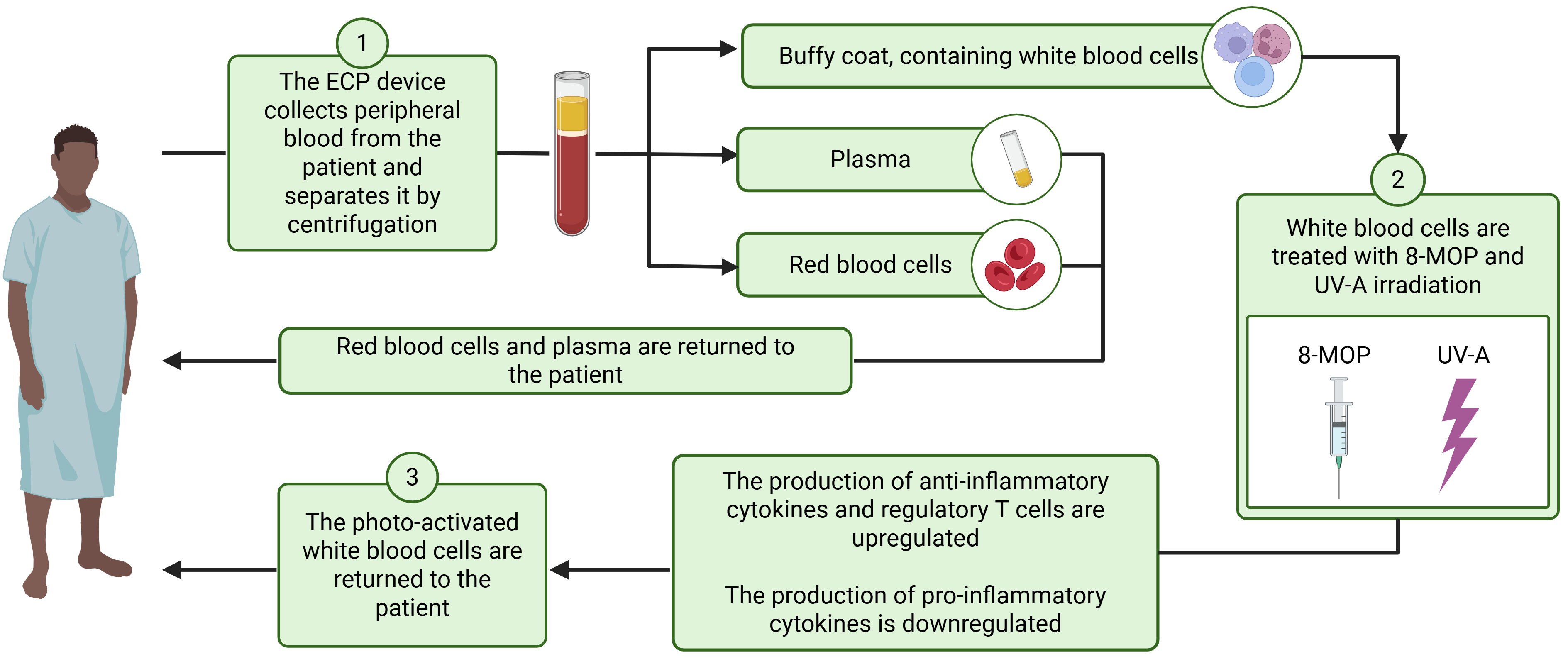
ECP has been shown to induce an immunomodulatory, rather than immunosuppressive, effect that may promote immune tolerance and enable immunosuppression-sparing in SOT recipients.3,5 Clinical evidence supporting the use of ECP, alone or in combination with other therapies, for the treatment of transplant rejection is more abundant in cardiothoracic transplantation compared with abdominal transplantation (Table 1).5 This disparity may, in part, reflect the absence of guidelines for its use in kidney and liver transplant recipients, among other contributing factors.17
Table 1. Studies investigating ECP for the treatment of heart, lung, and kidney transplant rejection*
| Publication and study type | Therapeutic regimen and rejection type | Study outcomes |
| Heart transplantation | ||
Teszak, et al. 202318 Single-center, retrospective study N = 22 | ECP + standard immunosuppression in patients with ACR or mixed rejection |
|
Barten, et al. 202319 Multicenter, retrospective study N = 105 | ECP + immunosuppression in patients with ACR, ABMR, or mixed rejection |
|
Savignano, et al.20 2017 Retrospective case series N = 8 | ECP in patients with recurrent, persistent, or mixed rejection with HC |
|
| Lung transplantation | ||
Benazzo, et al.21 2023 Multicenter, retrospective study N = 613 | ECP in patients with BOS or RAS |
|
Vazirani, et al.22 2021 Retrospective study N = 12 | ECP in patients with CLAD |
|
Leroux, et al.23 2022 Retrospective study N = 12 | ECP in patients with BOS |
|
Hage, et al.24 2021 Prospective, multicenter study N = 30 | ECP in patients with BOS refractory to standard immunosuppressive therapy |
|
Karnes, et al.25 2019 Retrospective study N = 60 | ECP in patients with treatment-refractory BOS |
|
Moniodis, et al.26 2018 Retrospective study N = 17 | ECP in patients with BOS or RAS |
|
| Kidney transplantation | ||
Augusto, et al.27 2021 Case series N = 3 | ECP + methylprednisolone + IV immunoglobulin in patients with mixed ACR |
|
Gregorini, et al.28 2021 Prospective, observational study N = 14 | ECP in patients with chronic ABMR and Grade 2–3 chronic renal failure |
|
Tamain, et al.29 2019 Retrospective study N = 33 | ECP in patients with ACR, ABMR, or chronic ABMR |
|
*Adapted from Barten, et al.5 in accordance with the Creative Commons Attribution (CC BY 4.0) license.
ACR, acute cellular rejection; ABMR, antibody-mediated rejection; BOS, bronchiolitis obliterans syndrome; cABMR, chronic ABMR; CLAD, chronic lung allograft dysfunction; DSA, donor-specific antibodies; ECP, extracorporeal photopheresis; EoT, end of treatment; FEV1, forced expiratory volume in 1 second; HC, hemodynamic compromise; HLA, human leukocyte antigen; ISHLT, The International Society for Heart and Lung Transplantation; pAMR, pathologic antibody-mediated rejection; RAS, restrictive allograft syndrome.
Challenges, limitations, and future directions
A European review investigating the current use and knowledge of ECP in solid organ transplantation found that awareness of ECP as a therapeutic option varied considerably by organ type, with 63%, 57%, 69%, and 24% of clinicians reporting awareness of ECP as a treatment option for heart, lung, kidney, and liver transplant rejection, respectively.17
Additionally, as ECP requires specialist equipment, facilities, and trained personnel, it may not be available at all transplant centers, limiting patient access.17 If patients are then required to travel to specialist centers for treatment, financial and logistical factors may further limit access.17 Variations in global healthcare systems mean reimbursement policies differ and may not cover the full cost of ECP, further limiting availability by socioeconomic status.17
When asked about factors that may encourage the use of ECP for SOT across organ types, European clinicians noted that more robust trial data supporting ECP for the treatment of transplant rejection, standardized protocols or guidelines, research into biomarkers to predict ECP outcomes, education on ECP, and stronger cost–benefit data would be beneficial (Table 2).17
Table 2. The percentage of European clinicians in agreement with factors that would increase the use of ECP in solid organ transplantation, per organ type*
| % of clinicians in agreement | ||||
| Factor | Heart (n = 13) | Lung (n = 8) | Kidney (n = 24) | Liver (n = 6) |
| More robust data for the use of ECP in the treatment of SOT rejection | 69 | 100 | 92 | 83 |
| Availability of standardized protocols/guidelines | 85 | 63 | 83 | 67 |
| Research into biomarkers to predict responses to ECP | 69 | 88 | 42 | 50 |
| Education on how to select candidates for ECP | 31 | 50 | 58 | 33 |
| Education on the mechanism of action and benefits of ECP | 38 | 13 | 58 | 50 |
| Stronger cost–benefit data | 15 | 63 | 42 | 17 |
| More robust data for the safety of ECP in solid organ transplantation | 15 | 0 | 46 | 33 |
*Adapted from Cashmore, et al.17 in accordance with the Creative Commons Attribution (CC by 4.0) license.
ECP, extracorporeal photopheresis; SOT, solid organ transplant.
Conclusions
Solid organ transplantation has transformed outcomes for patients with end-stage organ failure; however, rejection and the adverse effects of conventional immunosuppression continue to limit long-term graft survival.1–3 Immunosuppression-sparing approaches, therefore, represent an important shift in the management of SOT rejection.5 Among these strategies, ECP has emerged as a promising immunomodulatory treatment option.3,5 However, knowledge and use of ECP in the treatment of SOT rejection varies by organ type.17 Future research should focus on generating robust clinical trial data, establishing evidence-based guidelines across organ types, identifying predictive biomarkers to optimize patient selection, and improving clinician awareness and access to therapy.17 Collectively, these advances may expand the role of immunosuppression-sparing strategies and improve long-term outcomes for SOT recipients.5
This educational resource is independently supported by Therakos. All content is developed by SES in collaboration with an expert steering committee. Funders are allowed no influence.
References
Please indicate your level of agreement with the following statements:
The content was clear and easy to understand
The content addressed the learning objectives
The content was relevant to my practice
I will change my clinical practice as a result of this content
Your opinion matters
What do you consider to be the single greatest barrier to increased use of ECP in SOT patients at your center?