All content on this site is intended for healthcare professionals only. By acknowledging this message and accessing the information on this website you are confirming that you are a healthcare professional.
The SOT Hub website uses a third-party service provided by Google that dynamically translates web content. Translations are machine generated, so may not be an exact or complete translation, and the SOT Hub cannot guarantee the accuracy of translated content. The SOT Hub and its employees will not be liable for any direct, indirect, or consequential damages (even if foreseeable) resulting from use of the Google Translate feature. For further support with Google Translate, visit Google Translate Help.


The Solid Organ Transplantation Hub is an independent medical education platform, sponsored by Therakos. Funders are allowed no direct influence on our content. The levels of sponsorship listed are reflective of the amount of funding given. View funders.
Now you can support HCPs in making informed decisions for their patients
Your contribution helps us continuously deliver expertly curated content to HCPs worldwide. You will also have the opportunity to make a content suggestion for consideration and receive updates on the impact contributions are making to our content.
Find out more
Create an account to access:
Bookmark & personalize site content
Receive alerts for new content in your areas of interest
View solid organ transplantation content recommended for you
Improving treatment options to support solid organ transplantation
 Eric Epailly
 Donna Mancini
 Thomas Wekerle
 Anna Reed
 Markus Barten
Do you know... According to the 2023 American Society for Apheresis (ASFA) guidelines, which of the following is NOT a Category II indication for ECP in SOT?
During the SOT Hub Steering Committee Meeting on September 9, 2026, key opinion leaders met to discuss treatment options to support solid organ transplantation (SOT). The meeting opened with a presentation by Markus Barten, followed by a panel discussion featuring Donna Mancini, Thomas Wekerle, Anna Reed, and Eric Epailly.
Improving treatment options to support solid organ transplantation
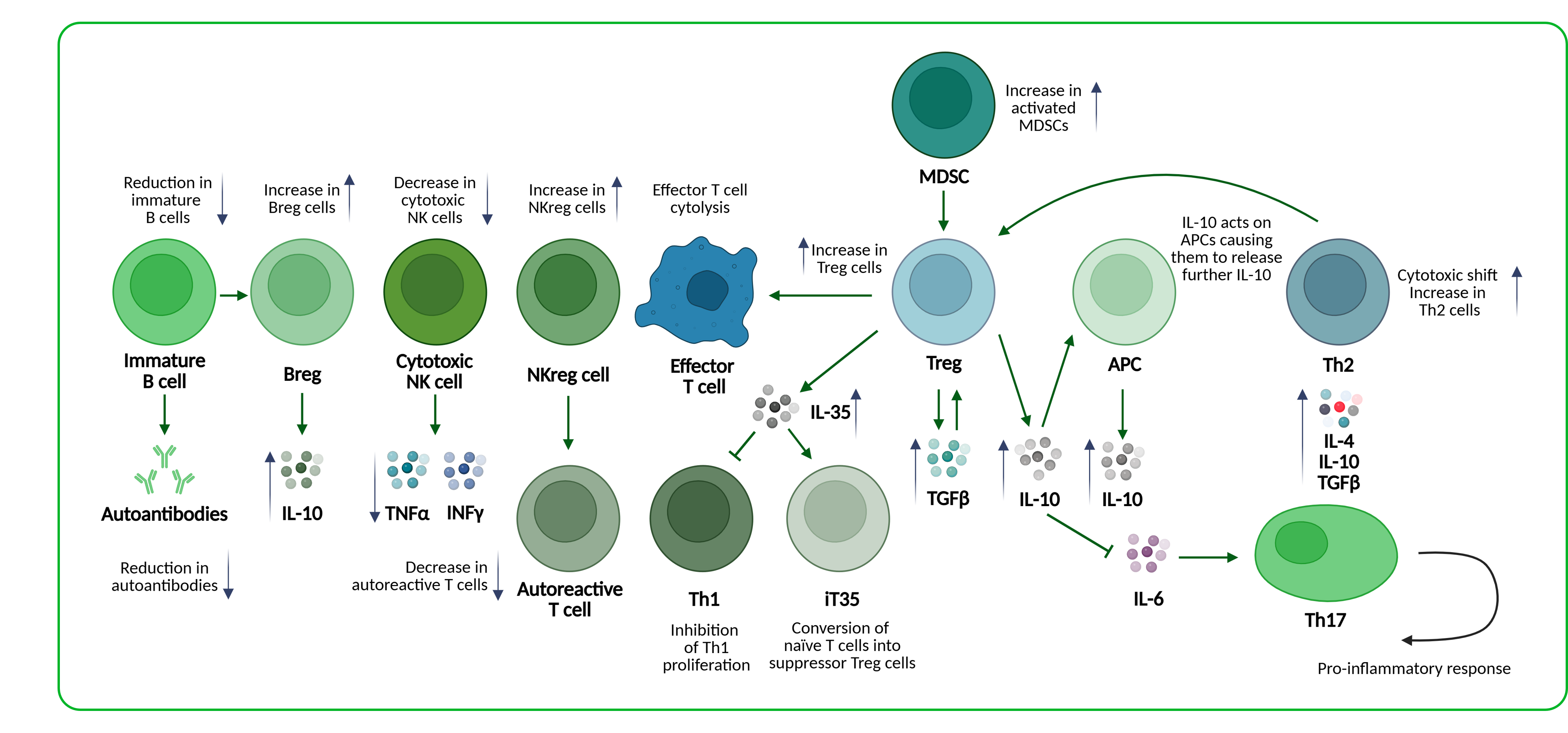
During his presentation, Barten highlights current immunosuppressive strategies and ongoing unmet needs in SOT. He provides an overview of immunomodulatory approaches that may help reduce the immunosuppressive burden, such as extracorporeal photopheresis (ECP), and explores its proposed mechanism of action (Figure 1) and key clinical data supporting its use across SOT indications. He concludes by discussing future directions and the potential implications for broader clinical practice. Barten and the steering committee members go on to discuss the potential role of ECP across SOT settings, including its use in different graft complications, approaches to patient selection, and priorities for future research.
Figure 1. ECP proposed mechanism of action*
Key points
- There are several significant unmet needs in SOT, including the prevention and management of allograft rejection and the serious complications associated with long-term immunosuppression.1
- Multidisciplinary risk stratification and precision diagnostics could support personalized immunosuppression strategies and the use of alternative immunomodulatory approaches, with the aim of reducing the immunosuppressive burden.1,4–7
- ECP is an immunomodulatory therapy that does not cause generalized immunosuppression, with its effects mediated by the induction of leukocyte apoptosis and subsequent modulation of immune responses.1
- Several retrospective and prospective studies have demonstrated the efficacy and safety of ECP in lung transplantation.1
- Results from a randomized controlled trial (NCT05721079) showed that the addition of ECP to standard triple immunosuppression after lung transplantation resulted in a reduction of acute cellular rejection (ACR) and a lower incidence of chronic lung allograft dysfunction (CLAD).8
- The prospective, multicenter, open-label, randomized E-CLAD UK trial (ISRCTN10615985) will assess the addition of ECP to standard care in the treatment of bilateral lung transplantation recipients with CLAD.9
- Retrospective evidence for the use of ECP in heart transplantation has shown that ECP in combination with standard immunosuppression can reduce ACR episodes compared with standard immunosuppression alone.1
- The American Society for Apheresis (ASFA) guidelines on the use of therapeutic apheresis in clinical practice include ECP as a Category II recommendation for heart transplantation in the treatment of cellular or recurrent rejection, and for rejection prophylaxis, and for lung transplantation in patients with CLAD, including bronchiolitis obliterans syndrome.10
- Early retrospective evidence suggests ECP may help stabilize or improve graft function in kidney transplantation, with evidence in liver transplantation emerging from small case series, pilot studies, and anecdotal reports.1,11
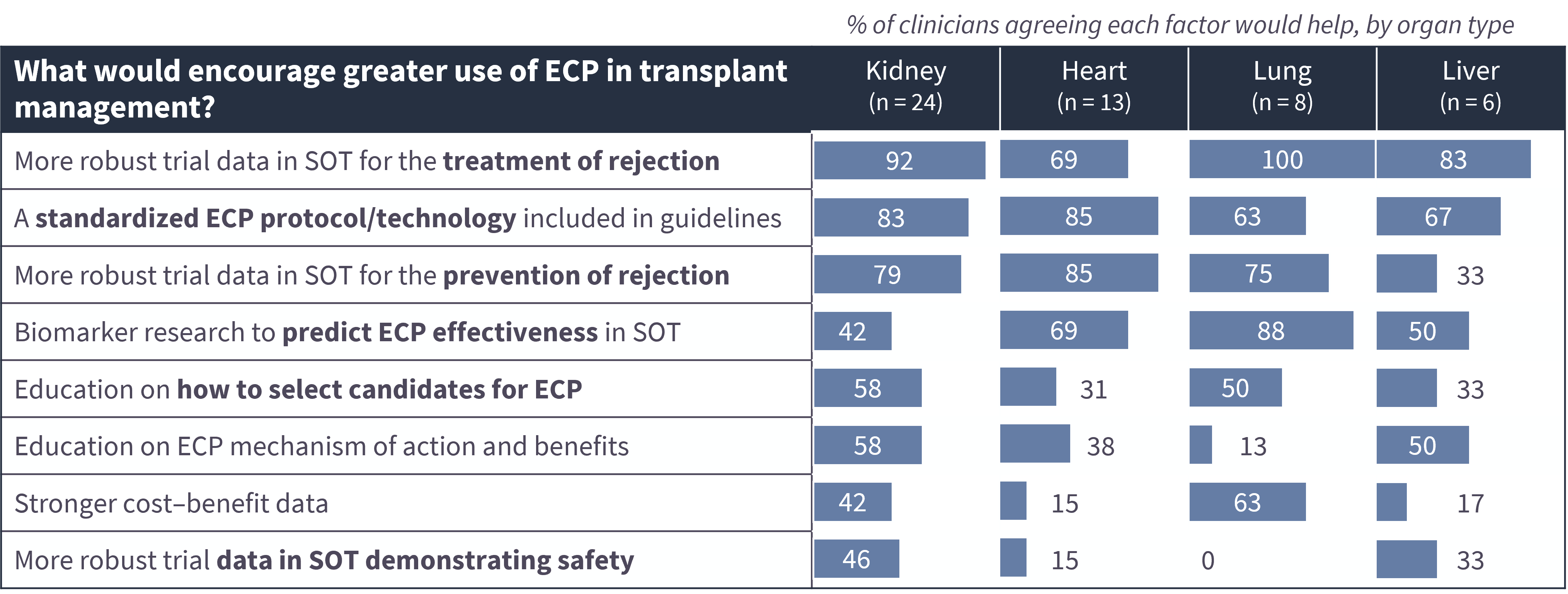
- A survey of 51 transplant clinicians highlighted factors that would encourage greater use of ECP in transplant management across indications, with top reasons including more robust clinical trial data and the development of a standardized protocol (Figure 2).11
- The potential role of ECP in preventing and managing rejection, particularly in high-risk or sensitized patients, remains an important area of investigation.1
- ECP may have broad potential as an effective therapy across a range of graft complications in appropriately selected patients, including acute and chronic rejection, recurrent ACR, progressive CLAD, antibody-mediated rejection, and in patients with recurrent infection.1,9
- In lung transplantation, improved phenotyping of CLAD may help identify patients most likely to benefit from ECP.7,12
- Further evaluation is needed to better understand the mechanism of action, identify patients most likely to benefit, establish optimal timing and treatment protocols, and determine whether ECP can reduce immunosuppressive exposure and associated toxicities.1
Figure 2. Percentage of European clinicians agreeing each factor would encourage greater ECP use, by organ type*†
This educational resource is independently supported by Therakos. All content is developed by SES in collaboration with an expert steering committee. Funders are allowed no influence.
References
- Barten MJ, Fisher AJ, Hertig A. The use of extracorporeal photopheresis in solid organ transplantation-current status and future directions. Am J Transplant. 2024;24(10):1731-1741. DOI: 10.1016/j.ajt.2024.03.012
- Garcia-Almeida JH, Heger L, Hackstein H. Extracorporeal photopheresis: Secreted factors that promote immunomodulation. Transplant Direct. 2025;11(9):e1840. DOI: 10.1097/TXD.0000000000001840
- Alwarawrah Y, Nichols AG, Patel I, et al. Targeting IL-6 receptor mediated metabolic pathways to control Th17 cell differentiation and inflammatory responses. Front Immunol. 2025;16:15685134. DOI: 10.3389/fimmu.2025.1568514
- Barten MJ, Zuckermann A. The meaning of donor-specific antibodies after heart transplant. Curr Opin Organ Transplant. 2019;24(3):252-258. DOI: 10.1097/MOT.0000000000000641
- Peled Y, Ducharme A, Kittleson M, et al. International Society for Heart and Lung Transplantation guidelines for the evaluation and care of cardiac transplant candidates-2024. J Heart Lung Transplant. 2024;43(10):1529-1628.e54. DOI: 10.1016/j.healun.2024.05.010
- Velleca A, Shullo MA, Dhital K, et al. The International Society for Heart and Lung Transplantation (ISHLT) guidelines for the care of heart transplant recipients. J Heart Lung Transplant. 2023;42(5):e1-e141. DOI: 10.1016/j.healun.2022.10.015
- Konduri A, Flynn KE, Huebschman A, et al. Donor-derived cell-free DNA as a marker for the efficacy of daratumumab in patients with antibody-mediated rejection post-heart transplantation: A case series. Pediatr Transplant. 2025;29(6):e70168. DOI: 10.1111/petr.70168
- Benazzo A, Cho A, Auner S, et al. Extracorporeal photopheresis for the prevention of rejection after lung transplantation: a prospective randomised controlled trial. Eur Respir J 2025;65(2):2400733. DOI: 10.1183/13993003.00733-2024
- Fisher AJ, White M, Goudie N, et al. Extracorporeal photopheresis (ECP) in the treatment of chronic lung allograft dysfunction (CLAD): a prospective, multicentre, open-label, randomised controlled trial studying the addition of ECP to standard care in the treatment of bilateral lung transplant patients with CLAD (E-CLAD UK). BMJ Open Respir Res. 2024 May;11(1):e001995. DOI: 10.1136/bmjresp-2023-001995
- Connelly-Smith L, Alquist CR, et al. Guidelines on the use of therapeutic apheresis in clinical practice - evidence-based approach from the Writing Committee of the American Society for Apheresis: The Ninth Special Issue. J Clin Apher. 2023;38(2):77-278. DOI: 10.1002/jca.22043
- Cashmore SJ, Barten MJ, Diekmann F, et al. Current usage of extracorporeal photopheresis in solid organ transplantations in Europe: A narrative review. Transpl Int. 2025;38:14906. DOI: 10.3389/ti.2025.14906
- Greer M, Dierich M, De Wall C, et al. Phenotyping established chronic lung allograft dysfunction predicts extracorporeal photopheresis response in lung transplant patients. Am J Transplant. 2013;13(4):911-918. DOI: 10.1111/ajt.12155
Please indicate your level of agreement with the following statements:
The content was clear and easy to understand
The content addressed the learning objectives
The content was relevant to my practice
I will change my clinical practice as a result of this content
This content is accurate as of the date of publication and is not updated retrospectively. Please refer to the latest available evidence, guidelines, and relevant regulatory information when making clinical decisions.
Your opinion matters
Which of the following additional evidence do you think would have the greatest impact on clinicians’ choice to adopt ECP in SOT?